The Tring Reservoirs are a haven for waterbirds such as Widgeon and Pintail and the viewing areas give easy access to watch or photograph the wildlife. Wilstone reservoir was orignally built in 1802 to supply the locks on the canal with water so canal boats could transport goods, livestock, grain and coal from London to the Midlands. The locks are used to make the water rise or fall so that boats can make the journey along the canal which is 400 feet difference between the lowest point in Brentford, and it's highest point, Tring summit. In late September and October the light is superb and early evening is great time to photograph the sunset as it disappears behind the trees. The area is located within a site of special scientific interest and is a managed nature reserve. The Tring reservoirs are famous for fishing, producing large perch, tench, carp and bream. They are made up of four reservoirs, Wilstone, Startops, Little Tring and Marsworth. These shots were captured using a Canon EOS 1DS Mark3 with two Canon zooms, a 24-70 2.8L and a 70-200 2.8LIS.
Monday, 28 September 2009
Tring Reservoirs
The Tring Reservoirs are a haven for waterbirds such as Widgeon and Pintail and the viewing areas give easy access to watch or photograph the wildlife. Wilstone reservoir was orignally built in 1802 to supply the locks on the canal with water so canal boats could transport goods, livestock, grain and coal from London to the Midlands. The locks are used to make the water rise or fall so that boats can make the journey along the canal which is 400 feet difference between the lowest point in Brentford, and it's highest point, Tring summit. In late September and October the light is superb and early evening is great time to photograph the sunset as it disappears behind the trees. The area is located within a site of special scientific interest and is a managed nature reserve. The Tring reservoirs are famous for fishing, producing large perch, tench, carp and bream. They are made up of four reservoirs, Wilstone, Startops, Little Tring and Marsworth. These shots were captured using a Canon EOS 1DS Mark3 with two Canon zooms, a 24-70 2.8L and a 70-200 2.8LIS.
Friday, 18 September 2009
Pitstone Windmill
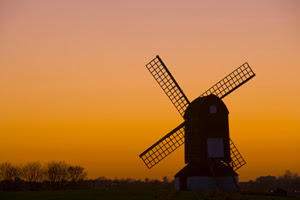
After a short trip to France, I returned home to the UK. September and October are excellent months to take night pictures as the sunsets are often colourful and provide beautiful muted light. One of my favourite places close to my home is Pitstone Windmill, an ancient post mill dating from 1627 that's believed to be the oldest in the British Isles. This was a working mill until it was destoyed during a gale in 1902. It was restored by volunteers and is now open to visitors on Sunday and bank holiday afternoons from June to August.
The windmill was dark and I wanted to avoid it becoming a silhouette in the picture. I lit it up from the side using a flash Canon 580EX Mark2 mounted on a lightstand and remotely controlled by a Pocket Wizard. As the windmill is quite big and the flash wasn't powerful enough, I set the aperture of my zoom, Canon 24-70 2,8L, to F4 to allow the dark wooden detail of the post mill to become visible. The flash combined with the sunset created this beautiful effect.
Friday, 11 September 2009
Macro Photography becomes easier with the new Canon lens Macro 100 2,8L IS
I am really excited that Canon have just launched their new lens, a 100mm f/2,8L IS macro USM which is part of the flagship 'L' series. Macro photography can be difficult as obtaining a sharp image can be challenging. But now, Canon have incorporated image stabilisation, the first of its type. The new Hybrid IS system means camera shake is corrected up to four stops on normal use and two stops when 1.0x magnified. Not only does it correct the shake if the camera moves side to side and up and down but this new system makes corrections if the camera moves backwards and forwards. This is why it is interesting particularly for macro work. Fewer pictures end up deleted and on the whole it makes macro photography a little easier. I hope to buy this lens and will post reviews and images in the near future.
Monday, 31 August 2009
The Cotentin
It is also possible to visit the landing beaches of WWII such as Utah and Omaha which may be particularly poignant for those whose relatives fought here over 60 years ago.
Thursday, 20 August 2009
Romantic Régneville

Régneville is a small town with a rich history. The « fours à chaux » in Régneville are disused limestone kilns that date back to the 19th century.
The local limestone used to be converted into quicklime and the kilns were powered by coal from Wales. Nowdays, the kilns are used as an amphitheatre to host concerts, ballets and plays during the summer months. 
The 18th century lighthouse at Agon Point gives an excellent view of Régneville. The estuary is enclosed by moving sand dunes so it's best to explore this area by foot.
The 14th century remains of Régneville castle can be seen on the journey from Monmartin-sur-mer to Régneville. It survived the 100 years' war only to be blown up by orders of King Louis XIII in 1637.
To take these shots I used a Canon EOS 1DS Mark 3 with Canon zooms 24-70 2.8L and 70–200 2.8 ISL.
The local limestone used to be converted into quicklime and the kilns were powered by coal from Wales. Nowdays, the kilns are used as an amphitheatre to host concerts, ballets and plays during the summer months. 
The 18th century lighthouse at Agon Point gives an excellent view of Régneville. The estuary is enclosed by moving sand dunes so it's best to explore this area by foot.
The 14th century remains of Régneville castle can be seen on the journey from Monmartin-sur-mer to Régneville. It survived the 100 years' war only to be blown up by orders of King Louis XIII in 1637.

To take these shots I used a Canon EOS 1DS Mark 3 with Canon zooms 24-70 2.8L and 70–200 2.8 ISL.
Subscribe to:
Posts (Atom)